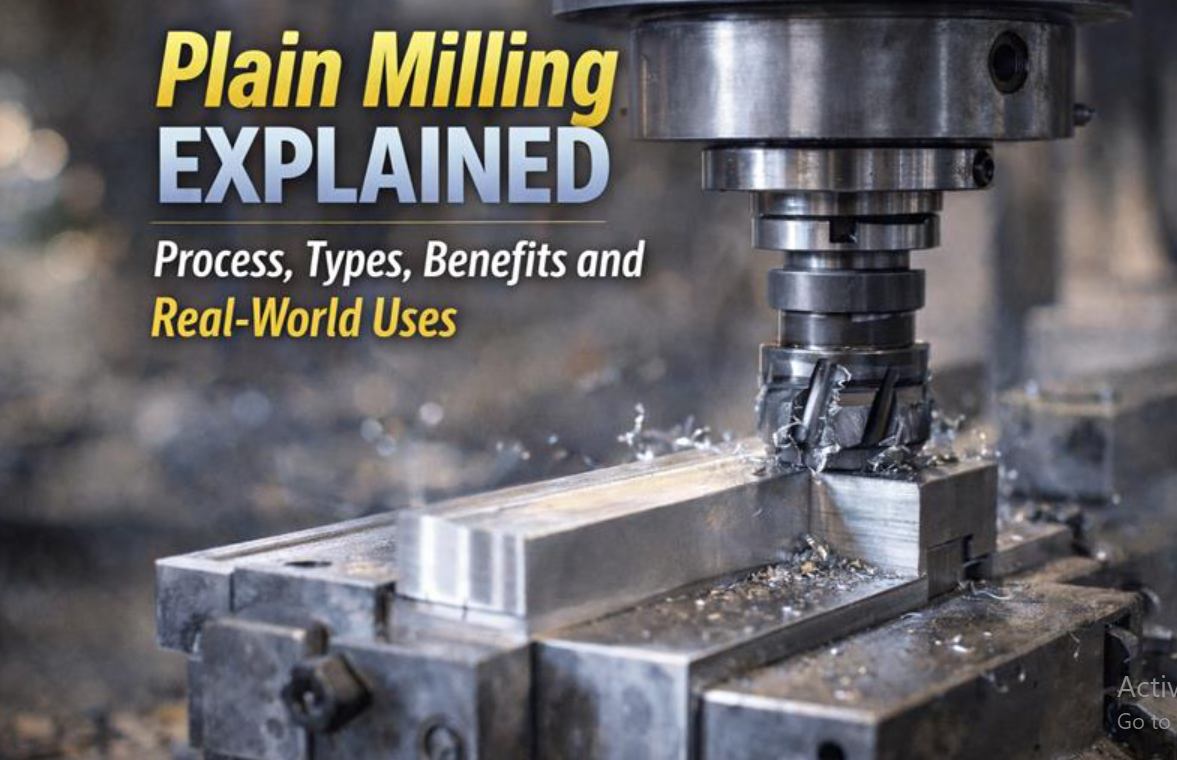
Plain milling is one of those machining basics that shows up everywhere, even if people do not always call it by name. If you have ever needed a clean, flat surface on a block, plate, or bracket, there is a good chance plain milling played a part. In modern workshops, cnc milling machining makes this process faster, more repeatable, and easier to control, especially when you are working to a tight drawing.
What is Plain Milling?
Plain milling is a milling process used to produce a flat surface by cutting along the outside edge of a rotating cutter. The cutter’s axis runs parallel to the surface being machined, and the teeth remove material as the work moves past the cutter.
You might also hear it called slab milling or peripheral milling. The goal is simple: remove stock evenly and leave a consistent, flat face. It is often used early in a job to square up raw material before moving on to features like holes, slots, pockets, or profiles.
A quick comparison helps: plain milling creates a flat surface with the cutter working around its perimeter, while face milling creates a flat surface with the cutter working mainly from its face.
Machine Setup and Tooling Basics
Plain milling is commonly done on a horizontal milling setup, though it can be achieved on other machines depending on the job. The typical tooling is a plain (slab) milling cutter mounted on an arbor. The cutter width is chosen to suit the surface you want to machine.
A few practical setup points matter a lot:
- Workholding: The part must be clamped securely so it cannot lift or shift under cutting forces.
- Alignment: Keeping the part square and stable helps you hit flatness and parallelism targets.
- Tool selection: Cutter diameter, cutter width, tooth count, and insert type all influence finish, chip control, and tool life.
When the setup is solid, the cut becomes predictable, which is exactly what you want for flat surfaces.
Plain Milling Process Step by Step
Here is how plain milling usually runs on the shop floor:
Step 1: Plan the cut
Confirm which face needs machining, how much stock must come off, and what the final finish and tolerance requirements are.
Step 2: Clamp and support the part
Use a vice, clamps, or a fixture that supports the part properly. If the part is thin, consider extra support to reduce vibration.
Step 3: Choose the cutter and settings
Set your spindle speed, feed rate, depth of cut, and width of cut. These settings are based on the material, cutter type, and how much stock you are removing. Coolant or air blast may be used to help with heat and chip clearing.
Step 4: Roughing pass
The roughing pass removes the bulk material. The focus is stability and consistent chip load. This is where you do the heavy lifting.
Step 5: Finishing pass
A lighter finishing cut improves surface finish and helps control flatness. This pass is usually slower and more controlled.
Step 6: Inspect
Measure the surface for flatness, size, and parallelism where required. Catching issues here saves time later in the job.
Types of Plain Milling
Plain milling can be grouped a few ways, but these are the most useful day to day:
Conventional (up milling) vs climb (down milling)
- Conventional milling tends to start with a thinner chip and finish with a thicker chip.
- Climb milling tends to start with a thicker chip and finish thinner, often giving a better surface finish when the machine and setup are rigid.
Roughing vs finishing
- Roughing is about removing stock quickly and safely.
- Finishing is about surface quality and holding size.
You choose the type based on material, rigidity, and the finish you need.
Advantages of Plain Milling
Plain milling earns its place because it is practical and reliable. Key benefits include:
- Fast stock removal on wide, flat faces
- Good control of flatness when the setup is stable
- Repeatability for batch work, especially with CNC programs
- Great as a prep step before more detailed operations like drilling or pocketing
For many parts, it is the cleanest way to turn rough stock into a usable starting point.
Limitations and Key Considerations
Plain milling is not the answer for everything. It is best suited to flat faces, so it is less useful for complex 3D shapes or internal features.
Common issues to watch for include chatter, tool deflection, and poor surface finish if the part is not clamped properly. Chip control also matters, especially on wide cuts, because built up chips can affect finish and tool life. If the drawing demands a very fine surface finish, you may still need a follow up process depending on the material and spec.
Applications and Where Plain Milling Fits
Plain milling shows up in a lot of real work because flat surfaces are everywhere. Typical uses include:
- Squaring plates and blocks
- Creating flat mounting faces on brackets, frames, and base plates
- Preparing stock before drilling, boring, or slotting
- Producing level surfaces that must mate cleanly with other parts
Across different industries, it is often used to create stable reference faces. For example, mining and heavy equipment parts may need flat mounting surfaces, aerospace fixtures often need accurate faces for repeatable positioning, and general engineering work regularly depends on flat faces for assembly alignment.
When jobs require consistent results and careful tolerances, many teams lean on cnc machining services to deliver surfaces that are square, true, and ready for the next operation.
Materials and Surface Finish Tips
Plain milling can be used on many materials, including aluminium, mild steel, alloy steels, cast iron, and some plastics.
To get a better finish, keep these basics in mind:
- Use sharp tooling suited to the material
- Keep the setup rigid and well supported
- Use sensible feeds and speeds to avoid chatter
- Clear chips properly, especially on wide passes
- Save a small allowance for a finishing pass rather than trying to do it all in one cut
Most finish problems come back to stability and chip control, not just the cutter.
Conclusion
Plain milling is a straightforward way to create accurate flat surfaces, whether you are squaring stock or preparing a part for more detailed machining. With the right cutter, a solid setup, and sensible cutting parameters, it delivers reliable results across a wide range of applications, including work commonly produced in cnc machining brisbane.
If you want to know about Decoding Web Accessibility: From Compliance To Inclusivity then visit our Tech category.